Hugster: Evaluating a Modern Serif for Luxury Branding
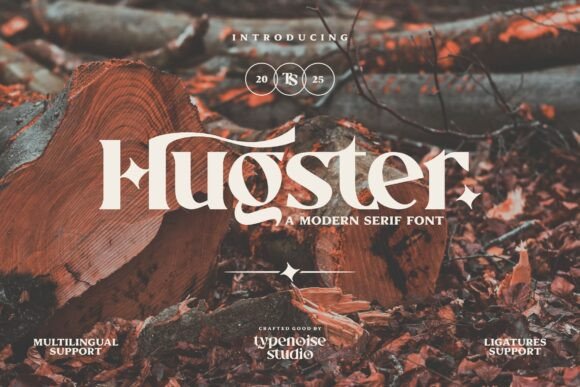
In the crowded landscape of contemporary typography, finding a typeface that balances historical reverence with modern utility is a persistent challenge for designers and brand strategists. Hugster enters this space as a modern serif font that explicitly aims to bridge the gap between classic typographic traditions and current digital aesthetics. Rather than relying solely on nostalgia or aggressive minimalism, Hugster presents a hybrid approach characterized by bold shapes, sharp edges, and an extensive set of elegant ligatures. For professionals tasked with building luxurious, characterful brand identities, understanding the practical application and technical nuances of this typeface is essential before integrating it into a design system.
Defining Characteristics and Visual Anatomy
Hugster distinguishes itself through a specific combination of structural weight and decorative refinement. While many modern serifs lean toward high-contrast thin lines that can be fragile in digital environments, Hugster utilizes bold shapes that maintain presence across various media. The sharp edges provide a necessary counterpoint to the organic curves typical of serif classifications, preventing the letterforms from appearing too soft or traditional. This geometric precision ensures that the font retains a contemporary feel even when used in classical layouts.
The most notable feature for expressive design work is the inclusion of subtle decorative details and alternative characters. These are not merely ornamental afterthoughts but are integrated into the glyph set to solve specific layout problems. The ligature characters, in particular, offer a level of polish that usually requires custom lettering. In professional typesetting, these connections prevent awkward spacing issues between specific character pairs while simultaneously adding a bespoke quality to headlines and logotypes. This attention to micro-typography suggests that Hugster was designed with high-end editorial and branding workflows in mind, rather than as a generic text face.
Performance in Digital and Print Environments
A typeface marketed for both digital and print use must pass rigorous legibility tests in both domains. Hugster’s bold construction serves it well on screens, where pixel density and rendering engines can sometimes erode finer details. The substantial stroke width ensures clarity on mobile devices and lower-resolution displays, making it a viable candidate for responsive web headers. However, users should exercise caution when scaling down; like many display-oriented serifs, Hugster performs best at larger point sizes. At body text sizes below 14px, the decorative elements and tight spacing may reduce readability, necessitating a pairing with a clean sans-serif or neutral serif for long-form content.
In print applications, the typeface reveals its full potential. The sharp edges translate crisply to offset and digital printing, allowing for precise ink trapping and edge definition. For luxury packaging, business cards, and editorial spreads, the tactile quality of the letterforms contributes significantly to the perceived value of the material. The contrast between the bold structure and delicate ligatures creates visual rhythm that guides the reader’s eye without causing fatigue, provided there is adequate whitespace. Designers working in print will find that Hugster rewards careful kerning and leading adjustments, as the default metrics are optimized for impact rather than dense text blocks.
Strategic Applications for Brand Identity
Hugster is specifically engineered for projects requiring a luxurious and elegant aesthetic. Its personality aligns naturally with industries where trust, heritage, and sophistication are paramount. Fashion labels, boutique hospitality brands, premium cosmetic lines, and artisanal food producers will find the typeface supports their narrative effectively. The font communicates established quality without feeling dated, which is crucial for legacy brands attempting to modernize or new entrants seeking instant credibility.
Beyond commercial branding, Hugster offers significant value for creative professionals and publishers. Book cover designers, magazine art directors, and wedding stationery creators can leverage the ligatures to create focal points that feel custom-designed. For freelancers and agency designers, having a reliable "luxury" serif in the toolkit reduces the time spent searching for appropriate display fonts. The versatility of the character set allows for variation within a single project; using standard glyphs for subheads and alternate ligatures for main titles maintains consistency while establishing hierarchy.
- Editorial Headlines: Use the bold weight with active ligatures for magazine covers and feature article titles to create immediate visual interest.
- Packaging Design: Leverage the sharp edges and substantial weight for shelf presence on wine labels, perfume boxes, and gourmet foods.
- Digital Hero Sections: Deploy large-scale typography on landing pages where the bold forms can anchor the composition against photography or negative space.
- Event Stationery: Utilize the elegant alternates for wedding invitations and gala programs to convey formality and personalization.
Practical Considerations and Workflow Integration
While Hugster excels in display settings, professionals must approach it with realistic expectations regarding workflow. The extensive ligature set requires software that supports OpenType features fully. Designers using older versions of Adobe Creative Cloud, Affinity Designer, or web platforms without proper CSS font-feature-settings support may struggle to access the special characters easily. It is advisable to test the font in your primary production environment before committing to it for a client project. Web developers, in particular, should verify that the WOFF2 files include the necessary lookup tables and that performance budgets allow for the additional file size associated with comprehensive glyph sets.
Pairing Hugster requires a disciplined approach. Because the typeface carries significant visual weight and distinct personality, it demands a supporting cast that recedes appropriately. Geometric sans-serifs with open apertures often provide the best balance, offering modern neutrality that lets Hugster’s character shine. Avoid pairing it with other highly decorative serifs or condensed typefaces, as this can create visual competition and clutter. In color usage, Hugster responds well to high-contrast combinations; gold foil on dark stock, white on charcoal, or deep navy on cream all enhance the luxurious intent of the design. Low-contrast pastel schemes may diminish the impact of the sharp edges and reduce overall legibility.
Evaluating Long-Term Value and Limitations
When investing in a typeface license, longevity is a key factor. Hugster avoids fleeting trend markers that might date a brand identity within two years. Its foundation in classic proportions provides a timeless skeleton, while the contemporary execution keeps it relevant. This duality suggests strong long-term value for brands that do not plan to rebrand frequently. However, users should recognize that Hugster is a specialized tool. It is not a workhorse family suitable for annual reports, user interfaces, or extensive documentation. Attempting to force it into these roles will likely result in accessibility issues and aesthetic friction.
Furthermore, the "luxury" association is a double-edged sword. For brands aiming for approachability, playfulness, or tech-forward innovation, Hugster may send the wrong signal. Its elegance reads as exclusive and refined, which can inadvertently create distance if warmth and inclusivity are the primary goals. Marketers and entrepreneurs must evaluate whether the typeface’s inherent tone matches their audience’s expectations. A/B testing in digital campaigns or gathering feedback during the concept phase can validate whether the typographic choice resonates with the target demographic before full implementation.
Ultimately, Hugster represents a thoughtful solution for specific design challenges. It succeeds because it does not try to be everything to everyone. By focusing on bold elegance, functional ligatures, and cross-media reliability, it serves a distinct niche in the professional designer’s arsenal. For those building brands where perception equals reality, and where every typographic detail contributes to a narrative of quality, Hugster offers a compelling blend of artistry and engineering. Success with this typeface depends less on the font itself and more on the designer’s ability to deploy it with restraint, technical competence, and strategic alignment with broader brand objectives.