Falsome Typeface: Evaluation for High-End Design Projects
Selecting the appropriate typeface is a foundational decision in visual communication, particularly when the objective is to convey luxury, femininity, or timelessness. Falsome is a serif typeface designed specifically to address these aesthetic requirements. It positions itself as a bridge between classic typographic charm and modern elegance, offering designers a toolset focused on refinement rather than utility. For professionals evaluating fonts for branding, editorial, or packaging projects, understanding the specific capabilities and limitations of Falsome is essential to determining its viability for high-end applications.
Defining the Aesthetic Profile
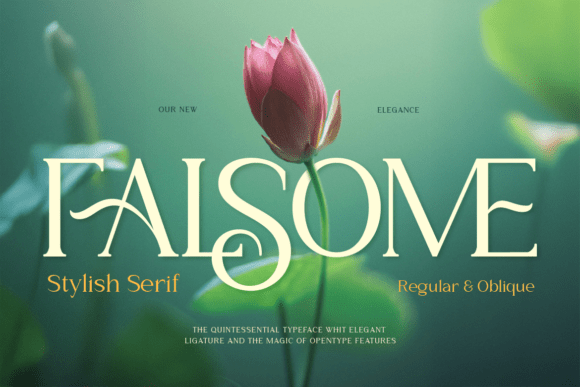
Falsome is categorized as a stylish serif, but its design language leans heavily toward the expressive side of the spectrum. Unlike transitional or slab serifs designed primarily for long-form reading, Falsome prioritizes visual impact and emotional resonance. The letterforms exhibit high contrast and delicate terminals, characteristics traditionally associated with fashion and luxury sectors. This aesthetic is not accidental; it is engineered to evoke a sense of sophistication and curated beauty.
The typeface distinguishes itself through meticulous attention to detail, specifically regarding ligatures and alternate characters. These features are integral to the font's identity rather than supplementary additions. Standard ligatures smooth out awkward spacing in common letter pairs, while discretionary ligatures and stylistic alternates allow for custom flourishes that mimic hand-lettering. This level of customization enables designers to create unique logotypes and headlines without resorting to manual vector manipulation, preserving the integrity of the original design while allowing for project-specific adaptation.
Functional Versatility Through Style Variations
A critical factor in evaluating any display typeface is its flexibility across different layout contexts. Falsome addresses this through two distinct styles: Regular and Oblique. While many serif families offer extensive weight ranges from thin to black, Falsome opts for a more restrained approach. This limitation is strategic rather than restrictive.
The Regular style serves as the anchor for static, authoritative statements. It provides the necessary structure for primary headings and brand names. The Oblique style, conversely, introduces dynamism and movement. In typographic composition, true obliques (as opposed to mechanically slanted italics) often feature redesigned letterforms that maintain optical balance at an angle. When layered together, the Regular and Oblique styles facilitate complex hierarchies and rhythmic layouts. This duality makes Falsome suitable for dynamic compositions where the interplay between stability and motion is required, such as in magazine spreads or event collateral.
Ideal Use Cases and Applications
Evaluating whether Falsome aligns with a project requires matching its strengths to specific design challenges. The typeface excels in environments where emotion and aesthetics take precedence over information density.
- Luxury Branding Identity: For brands in cosmetics, jewelry, or high fashion, Falsome provides an immediate signifier of quality. Its refined serifs and elegant proportions communicate heritage and exclusivity without appearing dated.
- Wedding and Event Stationery: The feminine and timeless qualities of the typeface make it a strong candidate for invitations, save-the-dates, and menus. The availability of alternates allows for personalized touches that elevate standard printed matter.
- Fashion Editorials: Magazine covers and feature headlines benefit from the font’s high contrast and expressive ligatures. It holds up well at large sizes, turning typography into a visual element that complements photography.
- Premium Packaging: On product labels and boxes, Falsome adds a tactile sense of value. The detailed craftsmanship translates well to embossing, foil stamping, and other print finishes common in luxury goods.
Tradeoffs and Practical Considerations
While Falsome offers significant aesthetic advantages, objective evaluation requires acknowledging its limitations. Understanding these tradeoffs prevents misuse and ensures client expectations are managed effectively.
Limited Weight Range
The most immediate consideration is the absence of multiple weights. Designers accustomed to variable fonts or extensive families may find the binary choice of Regular and Oblique constraining. If a project requires a subtle hierarchy involving light, medium, bold, and heavy weights for body copy, subheads, and captions, Falsome cannot function as a standalone solution. It must be paired with a complementary sans-serif or a more robust serif family to handle functional text duties.
Legibility at Small Sizes
Due to its high contrast and delicate details, Falsome is optimized for display use. At small point sizes or low resolutions, the thin strokes may disappear or pixelate. It is generally unsuitable for body text, legal disclaimers, or interface elements where readability is paramount. Evaluators should test the font at the intended reproduction size early in the selection process to avoid legibility issues in production.
Contextual Appropriateness
The distinct personality of Falsome means it carries strong connotations. It reads as inherently feminine and decorative. For corporate finance, technology, healthcare, or industrial branding, this tone may conflict with the desired message of neutrality, innovation, or robustness. In such cases, the font’s greatest strength becomes a liability.
Comparative Decision Making
When comparing Falsome against alternatives, the decision typically hinges on the balance between expression and utility. Geometric serifs or humanist typefaces may offer greater versatility and better screen performance, but they often lack the specific romantic and luxurious character that Falsome embodies. Conversely, script fonts may offer similar elegance but can suffer from poor scalability and legibility in all-caps settings. Falsome occupies a middle ground: it retains the structural clarity of a serif while delivering the decorative appeal usually reserved for scripts.
For designers seeking a typeface that brings emotion and beauty to their work while remaining easier to set than a full script, Falsome presents a compelling option. However, if the project demands extensive typographic variation, multi-language support beyond standard Latin sets, or high-density text setting, exploring broader super-families may be more prudent.
Final Assessment for Selection
Falsome is a specialized instrument in the typographic toolkit. It is best evaluated not as a general-purpose workhorse, but as a targeted solution for projects demanding high visual impact and emotional connection. Its success depends entirely on correct application within its niche. When used for headlines, logos, and short-form display text in luxury or lifestyle contexts, it delivers a polished, professional result that justifies its selection. By recognizing both its refined capabilities and its functional boundaries, designers can leverage Falsome to create visuals that are both stunning and strategically sound.