Evaluating Whitcher: A Practical Guide to Modern Blackletter Typography
Selecting the appropriate typeface for dark fantasy, historical fiction, or niche branding requires balancing aesthetic impact with functional legibility. Whitcher is a blackletter display font designed to address this specific intersection. It presents a bold interpretation of gothic tradition, modified with contemporary design sensibilities and mystical stylistic alternates. For designers and authors evaluating type options, understanding the specific characteristics, applications, and limitations of Whitcher is essential for determining its suitability for a given project.
Defining the Whitcher Aesthetic
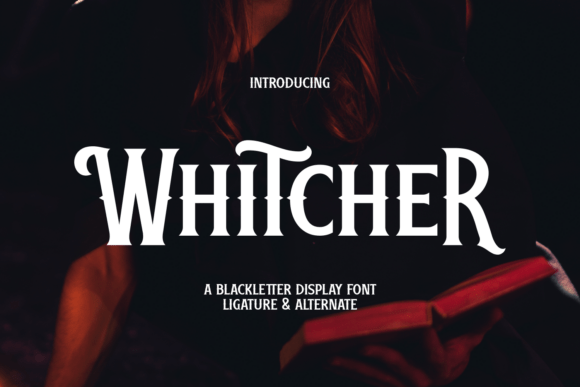
Whitcher distinguishes itself from standard medieval revivals through a deliberate fusion of sharp verticality and sweeping curves. While traditional Fraktur or Textura scripts often prioritize rigid historical accuracy, Whitcher introduces a fantasy-oriented stylization. The letterforms retain the high-contrast strokes and dense texture associated with gothic typography but incorporate smoother transitions and exaggerated terminals. This creates a visual tone that reads as "magical" rather than strictly ecclesiastical or academic.
A defining feature of this typeface is its inclusion of ligature alternates. These are not merely decorative flourishes; they serve to break up the repetitive rhythm typical of blackletter scripts. By connecting specific character pairs or offering swash variants, Whitcher allows for custom word shapes that can enhance logo lockups or title treatments. This flexibility suggests the font was engineered for display environments where unique composition matters more than uniform text blocks.
Primary Use Cases and Applications
Evaluation of Whitcher should focus on its intended environment. As a display typeface, it performs best at large sizes where intricate details remain visible. The following scenarios represent strong fits for this typeface:
- Dark Fantasy Book Covers: The font’s weight and mystical undertones align naturally with genres involving magic, folklore, or grimdark narratives. It provides immediate genre signaling to potential readers browsing thumbnails.
- Game Titles and UI Headers: In video games or tabletop RPGs, Whitcher works effectively for main titles, chapter headers, or inventory categories. Its bold construction ensures readability against complex background artwork or textured interfaces.
- Niche Branding and Packaging: For products requiring a vintage or artisanal aesthetic—such as craft beverages, apothecary-style cosmetics, or metal music merchandise—Whitcher offers a polished alternative to distressed or grunge fonts.
- Event Signage and Posters: The high contrast and distinct silhouette make it suitable for short-form messaging where atmosphere is prioritized over information density.
Benefits and Strategic Advantages
When compared to generic blackletter fonts, Whitcher offers several practical advantages for creative projects. The primary benefit is its modern edge. Many historical revivals can appear stiff or overly archaic to contemporary audiences. Whitcher’s smoothed curves and balanced proportions make it accessible while retaining thematic authenticity. This accessibility is crucial for commercial projects that need to evoke the past without alienating modern consumers.
Additionally, the integrated ligature system reduces the need for manual vector editing. Designers often spend significant time adjusting kerning or drawing custom connections in blackletter work to avoid awkward spacing. Having these solutions built into the OpenType features streamlines the workflow and ensures typographic consistency across different words and layouts. The bold weight also addresses a common issue in digital reproduction; many thinner gothic fonts lose detail when scaled down for web use or print at lower resolutions, whereas Whitcher maintains structural integrity.
Tradeoffs and Limitations
Despite its strengths, Whitcher is not a universal solution. Objective evaluation requires acknowledging constraints that may necessitate alternative choices:
- Poor Body Text Legibility: The dense structure and ornate details that make Whitcher striking at 72pt render it illegible at 12pt. It cannot function as body copy. Projects requiring extensive reading text will need a complementary serif or sans-serif typeface.
- Genre Specificity: The "mystical twist" limits versatility. While perfect for fantasy, it may feel out of place for corporate legal documents, medical branding, or minimalist tech interfaces. The personality of the font is dominant and difficult to neutralize.
- Language Support Considerations: Display fonts with extensive alternates sometimes have limited character sets compared to comprehensive text families. Users must verify support for specific diacritics or non-Latin scripts before committing to the typeface for international projects.
- Visual Weight Conflicts: Because Whitcher is inherently bold, pairing it with other heavy display fonts can create visual competition. It demands negative space or lighter supporting elements to prevent a cluttered layout.
Comparative Evaluation: When to Choose Alternatives
Deciding whether to use Whitcher involves comparing it against other categories of gothic typography. If the project demands strict historical accuracy for a museum exhibition or academic publication, a faithful Textura or Rotunda revival would be more appropriate. Whitcher’s fantasy elements, while engaging, introduce an anachronistic quality that undermines scholarly rigor.
Conversely, if the goal is horror or decay, Whitcher’s elegance may be too refined. Distressed, eroded, or scratchy blackletters communicate visceral dread more effectively than Whitcher’s clean vectors. Similarly, for projects requiring a softer, more romantic medieval feel, uncial or half-uncial scripts offer rounder, less aggressive forms. Whitcher occupies a specific middle ground: it is darker than romance but cleaner than horror, making it ideal for epic fantasy and premium vintage branding but less suited for extremes of either end of the spectrum.
Practical Decision-Making Framework
To determine if Whitcher aligns with current project goals, consider the following evaluation criteria:
- Hierarchy Assessment: Does the project require a dominant headline font, or is the primary need extended reading? If the latter, look elsewhere.
- Tone Alignment: Review the mood board. If keywords include "epic," "arcane," "bold," or "refined," Whitcher is a candidate. If keywords are "minimal," "corporate," "gritty," or "academic," reconsider.
- Technical Verification: Test the specific ligatures needed for key words (e.g., brand names or title phrases). Ensure the alternate characters improve the shape rather than creating new spacing issues.
- Pairing Strategy: Identify a secondary typeface before licensing. Whitcher pairs best with simple, low-contrast serifs or clean geometric sans-serifs. Avoid pairing it with other decorative scripts.
- Reproduction Context: Consider the final output medium. For embroidered merchandise or small-scale engraving, test the minimum viable size. Intricate ligatures may need to be disabled for physical production methods with low tolerance for fine detail.
Ultimately, Whitcher serves as a specialized tool within the typographic arsenal. Its value lies in its ability to modernize the blackletter aesthetic for contemporary fantasy and branding contexts without sacrificing the genre's inherent gravity. By weighing its distinctive stylistic features against practical legibility requirements and project-specific tonal goals, designers can make an informed decision about its integration into their visual systems. Successful implementation depends not just on the font's beauty, but on respecting its boundaries as a display-only instrument designed for atmospheric storytelling.