Diligent: Evaluating a Graceful Handwritten Font for Professional Branding
In the crowded landscape of digital typography, finding a script font that balances aesthetic beauty with functional legibility is a persistent challenge for designers and business owners. Diligent emerges as a noteworthy contender in this space, offering a graceful handwritten aesthetic defined by flowing strokes and stylish curves. Unlike many decorative scripts that prioritize ornamentation over readability, Diligent maintains a refined design that feels both professional and personal. This duality makes it a versatile asset for specific commercial and creative applications, ranging from feminine branding to formal invitations.
For professionals evaluating typefaces for long-term use, the value of a font lies not just in its visual appeal but in its reliability across different media. Diligent’s balanced script style adds sophistication without sacrificing hand-crafted charm, positioning it as a practical tool rather than merely a decorative novelty. Understanding its specific characteristics, optimal use cases, and technical limitations is essential for determining whether it aligns with your current project requirements or brand identity strategy.
Defining Characteristics and Design Integrity
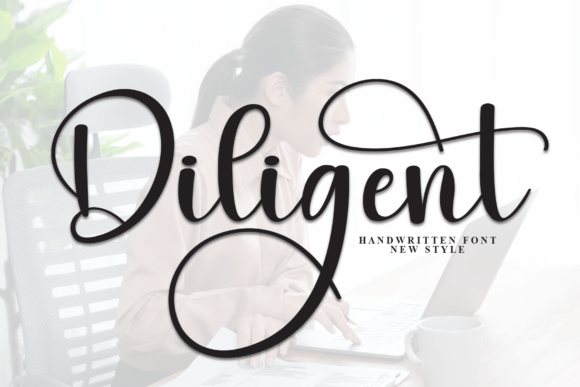
Diligent is categorized as a connecting script, but its construction suggests a deliberate focus on rhythm and spacing that separates it from generic handwriting fonts. The letterforms exhibit a consistent stroke weight that avoids the erratic thickness variations often found in lower-quality digitized scripts. This consistency is crucial for maintaining professionalism in business contexts. The curves are smooth and intentional, avoiding sharp angles or awkward joins that can distract the reader or degrade when scaled down.
The typeface carries an inherent elegance that leans toward traditional calligraphy while retaining modern accessibility. It does not attempt to mimic messy casual handwriting; instead, it presents a polished version of penmanship. This "refined casualness" is its primary strength. For entrepreneurs and marketers, this means the font communicates warmth and human touch without appearing unprofessional or amateurish. The ligatures and connections between characters flow naturally, creating a cohesive word shape that enhances readability even at smaller sizes than typical display scripts allow.
Visual Tone and Emotional Resonance
Typography carries emotional weight, and Diligent projects a tone of approachable luxury. In branding psychology, this specific intersection of traits is highly valuable for industries that rely on trust and personal connection. The font avoids the stiffness of serif typefaces and the informality of rounded sans-serifs, occupying a middle ground that suggests care and attention to detail. When used in quote designs or social media graphics, the text feels authored rather than generated, which can significantly increase engagement rates for content creators and educators sharing wisdom or inspirational messages.
Practical Applications in Business and Creative Workflows
Evaluating Diligent requires looking beyond static specimens to consider how it performs in active workflows. Its versatility allows it to function effectively across several distinct categories, provided the user respects its design parameters.
- Feminine Branding and Identity: This is perhaps the strongest use case for Diligent. Beauty salons, boutique fashion labels, wedding planners, and wellness coaches benefit from its soft yet structured appearance. It pairs exceptionally well with minimalist sans-serif body copy, allowing the brand name to serve as a focal point without overwhelming the overall layout.
- Formal Invitations and Stationery: For wedding suites, gala tickets, and corporate event announcements, Diligent offers a cost-effective alternative to custom hand-lettering. Its high legibility ensures that guests can easily read names, dates, and venues, reducing the friction often associated with ornate script fonts.
- Business Cards and Signatures: Using Diligent for a name or signature line on a business card adds a bespoke quality to networking collateral. Because the strokes remain clear at small point sizes, it remains functional in print production where ink spread could otherwise destroy finer details.
- Social Media and Quote Graphics: Content creators and publishers will find that Diligent photographs well against textured backgrounds. The open counters and generous x-height prevent the letters from disappearing into busy photography, making it reliable for Instagram carousels, Pinterest pins, and blog headers.
Technical Usability and Production Considerations
A beautiful font is useless if it causes production headaches. From a technical standpoint, Diligent demonstrates solid craftsmanship. The glyph set typically includes necessary alternates and ligatures that prevent repetitive character patterns, a common flaw in digital scripts that breaks the illusion of natural handwriting. Designers should utilize OpenType features to access these variations, ensuring that repeated letters like double 'o's or 'l's appear distinct and organic.
Legibility remains a critical factor in usability. While Diligent is more readable than many peers, it is still a script. Professionals must exercise restraint regarding capitalization. Using all-caps with any connecting script, including Diligent, destroys the connecting lines and renders the text nearly illegible. It is designed strictly for title case or sentence case usage. Furthermore, while it scales up beautifully for signage or large-format prints, users should test minimum point sizes for their specific output medium. On low-resolution screens or porous paper stocks, the fine connecting strokes may require slight tracking adjustments or bolding to maintain integrity.
Pairing Strategies for Balanced Layouts
Diligent possesses enough personality to stand alone, but effective design often requires pairing. Because the font has significant contrast and curvature, it demands a grounding partner. Geometric sans-serifs (such as Montserrat or Futura) provide a stable foundation that lets Diligent shine without competing. Alternatively, a clean, high-contrast serif can reinforce the traditional elegance of the script. Avoid pairing Diligent with other decorative fonts or highly stylized serifs, as this creates visual noise and diminishes the professional impact of the composition. The goal is to let the script serve as the accent, not the entire conversation.
Assessing Value for Different User Segments
Determining whether Diligent is the right investment depends heavily on your specific role and objectives. Not every project requires a refined script, and misapplying this style can undermine communication goals.
For Small Business Owners and Freelancers: If your business relies on personal relationships, artisanal quality, or aesthetic services, Diligent offers high ROI. It elevates DIY marketing materials to a level that rivals agency work. However, if you operate in tech, finance, law, or heavy industry, this font may send the wrong signal. Those sectors typically require stability and authority conveyed through robust serifs or neutral sans-serifs.
For Educators and Publishers: Diligent is excellent for headers, pull quotes, and certificate text. It adds variety to educational materials without compromising clarity. However, it should never be used for body text or instructional paragraphs. Reserve it for emphasis and titling to maintain reading comprehension and accessibility standards.
For Marketers and Agencies: Keep Diligent in your toolkit for lifestyle, hospitality, and wellness clients. Its flexibility across digital and print formats reduces the need to license multiple script fonts for a single campaign. Just ensure you have verified the licensing terms for commercial use, particularly for client deliverables and merchandise.
Limitations and Realistic Expectations
No typeface is universally perfect, and objective evaluation requires acknowledging limitations. Diligent is not suitable for dense information architecture. Navigation menus, legal disclaimers, data tables, and long-form articles are inappropriate environments for this style. Attempting to force Diligent into these roles will result in poor user experience and accessibility failures.
Additionally, while the font mimics handwriting, astute viewers can still identify it as a digital product upon close inspection. It lacks the true randomness of analog calligraphy. For ultra-high-end luxury brands where uniqueness is paramount, Diligent serves best as a placeholder or secondary element rather than a replacement for custom lettering. It bridges the gap between budget constraints and premium aesthetics, but it does not eliminate the distinction entirely.
Finally, consider the cultural context of your audience. Script fonts carry gendered and stylistic connotations. While Diligent is versatile within the realm of elegant scripts, it inherently codes as feminine or traditional. Ensure this alignment matches your target demographic's expectations and your brand's core values before committing to it as a primary identifier.
Making the Final Decision
Diligent succeeds because it solves a specific problem: providing a handwritten aesthetic that doesn't sacrifice professional credibility. Its flowing strokes and stylish curves offer immediate visual interest, while its balanced construction ensures it remains usable in real-world commercial applications. For the adult professional, entrepreneur, or creator seeking to add warmth and sophistication to their visual communications, it represents a reliable and effective choice.
However, successful implementation requires discipline. Respect the font's intended purpose, avoid typographic misuse, and pair it thoughtfully with supporting typefaces. When applied correctly, Diligent transforms standard text into an engaging visual experience that resonates with audiences seeking authenticity and elegance. Evaluate your current project needs against these strengths and limitations to determine if this graceful script is the missing component in your design system.