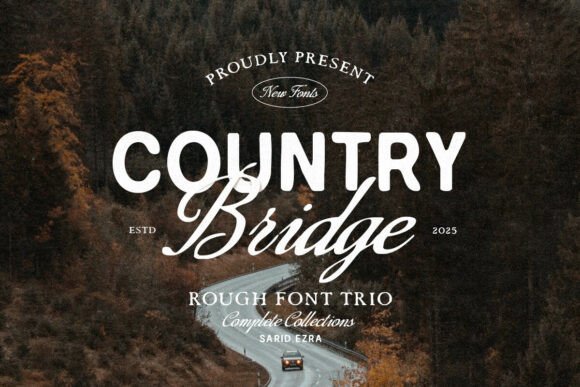
Country Bridge Trio: Mastering Vintage Typography Without the Guesswork
Achieving an authentic, organic aesthetic in digital design often feels like walking a tightrope. You want the warmth of handmade lettering without sacrificing legibility, and you desire vintage charm without looking dated or messy. This is precisely where the Country Bridge Trio enters the workflow. It is not merely a single typeface but a curated collection of three distinct styles designed to complement one another seamlessly. For designers, marketers, and small business owners who have struggled with font pairing, this system removes the friction from creating cohesive branding, wedding invitations, and editorial layouts.
However, owning a versatile font collection does not automatically guarantee professional results. Many creators download rough, textured fonts expecting them to solve their design problems instantly, only to find their final output looks cluttered or unprofessional. The issue rarely lies with the typeface itself; rather, it stems from how the font is applied. Understanding the nuances of Country Bridge—and avoiding common typographic pitfalls—is essential for leveraging its full potential.
Understanding the Organic Versatility of Country Bridge
Before diving into application strategies, it is helpful to clarify what makes this trio different from standard script or serif fonts. Country Bridge is categorized as a rough font family, meaning it carries intentional texture and irregularity that mimics analog printing or hand-painting. If you are familiar with the elegance of Royale Couture, think of Country Bridge as its rustic, natural counterpart. It retains sophisticated structure but swaps polished edges for organic grit.
The "Trio" aspect is the most critical feature for efficiency. Instead of hunting for a matching sans-serif or accent font, you receive three weights or styles engineered to work in harmony. This includes support for multilingual characters, numbers, and symbols, which is frequently overlooked during the purchasing phase. A common mistake is assuming all decorative fonts include comprehensive language support, leading to broken layouts when designing for international clients or bilingual events. Country Bridge addresses this practical need, ensuring your vintage aesthetic doesn't break when you switch languages or add numerical data.
Common Mistakes When Using Rough Textured Fonts
Even experienced designers can misstep when working with textured typography. Because Country Bridge has so much built-in character, it demands a different approach than clean, geometric typefaces. Here are the most frequent errors that compromise quality and usability.
Overusing Texture at Small Sizes
The most prevalent error is using the roughest style of the trio for body copy or small details. While the texture looks beautiful at headline scale, those same organic imperfections can reduce legibility significantly when scaled down below 14pt. Ink bleed simulation and rough edges that look artistic at 72pt become visual noise at 10pt.
The Correction: Reserve the primary rough style for logotypes, large quotes, and headers. Utilize the cleaner or lighter variations within the Country Bridge Trio for subheads, captions, and functional text. This hierarchy maintains the vintage mood while ensuring your audience can actually read the content. Always test your smallest intended size on both screen and print before finalizing the layout.
Ignoring Negative Space in Logotypes
Rough fonts naturally occupy more visual weight than their clean counterparts because of the external texture. Designers often set Country Bridge in a logo mark using standard tracking settings, resulting in letters that feel cramped or muddy. When the internal counters (the holes in letters like 'o', 'e', or 'a') fill in due to texture, the brand mark loses definition.
The Correction: Increase tracking slightly when setting logotypes with this trio. Give the texture room to breathe. If you are designing for embroidery or small-scale printing, consider using the smoothest version of the trio for the icon and reserving the rough version for larger accompanying text. This prevents production issues where fine details get lost in physical media.
Mismatching the Vibe with Imagery
A subtle but impactful mistake is pairing Country Bridge with imagery that contradicts its organic nature. Placing this rough, vintage trio over sleek, high-gloss corporate photography or neon cyberpunk aesthetics creates cognitive dissonance. The font promises authenticity and heritage; if the supporting visuals scream synthetic modernity, the design fails to communicate clearly.
The Correction: Align your visual assets with the typeface’s personality. Country Bridge excels alongside matte textures, film grain, botanical illustrations, linen backgrounds, and warm color palettes. If you must use modern photography, apply a subtle grain overlay or desaturate the image to bridge the gap between the photo and the rough typography.
Practical Checks Before Buying or Downloading
To ensure Country Bridge Trio is the right investment for your specific project, run through this pre-purchase checklist. This saves time and prevents buyer’s remorse.
- Verify Language Requirements: Although this trio supports multilingual characters, always check the specific language list against your project needs. If you are designing for a niche dialect or specific regional accents, confirm glyph availability in the product details first.
- Assess Output Medium: Where will this live? For web use, ensure you have access to WOFF/WOFF2 files and understand how texture renders on low-resolution screens. For print, verify that the texture resolution is high enough for your intended DPI. Rough fonts that look great on Instagram may pixelate on a business card if the source file isn't vector-based or high-res.
- Evaluate Licensing Scope: Are you using this for a personal wedding invitation or a commercial product package? Desktop licenses differ from commercial or app licenses. Confirming this upfront avoids legal complications and unexpected costs later.
- Test Pairing Potential: Even though the trio is self-contained, you may need to pair it with existing brand fonts. Download a trial or preview the specimen sheet to ensure Country Bridge doesn’t clash with your current corporate sans-serifs or serifs.
Maximizing Efficiency in Branding and Weddings
For wedding stationers and brand designers, the primary value of Country Bridge is speed without sacrifice. Font pairing is typically the most time-consuming part of the initial concept phase. By utilizing a pre-matched trio, you eliminate hours of testing incompatible combinations.
When designing wedding suites, use the boldest rough style for the couple's names, the secondary style for event details (date, time, venue), and the tertiary style for RSVP cards or fine print. This creates a unified tactile experience across multiple pieces of stationery. Similarly, for artisanal brands, use the trio to differentiate product tiers: the roughest style for premium lines, the medium for standard products, and the cleanest for ingredients lists or regulatory text.
Ultimately, Country Bridge Trio serves as a corrective tool for designs that feel too sterile or overly chaotic. It offers a middle ground where vintage aesthetics meet modern functionality. By respecting its textural limits, verifying technical specs, and applying it with intention, you transform a simple font download into a reliable asset for authentic communication.