Evaluating Crashbow for Modern Display Typography
In the crowded landscape of display typography, finding a brush font that balances artistic expression with commercial legibility is a persistent challenge for designers. Crashbow enters this space as a modern brush typeface designed specifically for high-impact visual communication. Unlike traditional script fonts that often prioritize ornate flourishes over readability, Crashbow adopts a contemporary aesthetic that feels both handcrafted and structured. For professionals ranging from freelance graphic designers to marketing directors, understanding the specific utility of this typeface is essential before integrating it into a production workflow.
The primary value proposition of Crashbow lies in its versatility within the display category. It is engineered to serve as a focal point rather than a background element. When evaluating typefaces for posters, logos, magazines, book covers, and banners, the font must possess enough character to stand alone while remaining flexible enough to adapt to various brand voices. Crashbow achieves this through a deliberate design strategy that merges the organic energy of brush lettering with the geometric stability required for modern layout design. This duality makes it a practical asset for projects that need to convey creativity without sacrificing professional polish.
Design Characteristics and Visual Mechanics
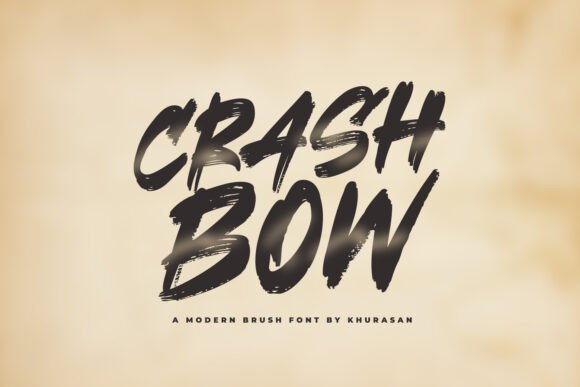
To determine if Crashbow fits a specific project, one must analyze its construction. The font features bold, confident strokes that mimic the pressure sensitivity of a physical brush, yet the vector paths are clean and optimized for digital rendering. This technical quality ensures that the font performs reliably across different media, from large-format print banners to social media graphics. The quirks in the letterforms are intentional but controlled; they add human warmth without introducing visual noise that could hinder quick comprehension.
A significant strength of Crashbow is its x-height and open counter spaces. Many decorative brush fonts suffer from tight spacing and low x-heights, making them illegible at smaller sizes or in all-caps settings. Crashbow maintains generous internal whitespace, which preserves legibility even when used in headline applications where space is constrained. The baseline alignment is also consistent, preventing the "bouncing" effect common in hand-lettered styles. This consistency allows designers to set multiple lines of text with predictable leading and tracking, reducing the time spent on manual optical adjustments during the layout phase.
Practical Applications in Professional Workflows
The real-world performance of Crashbow varies depending on the application. In logo design, the font provides an immediate sense of approachability and dynamism. It works particularly well for brands in the lifestyle, food and beverage, creative agency, and artisan retail sectors. However, because of its distinct personality, it may be less suitable for corporate finance, legal services, or medical institutions where conservative serif or sans-serif typefaces are the industry standard. Designers must weigh the brand’s tone against the font’s inherent playfulness.
For editorial design, such as magazine covers and book jackets, Crashbow serves as an effective hierarchy tool. It creates a strong contrast when paired with minimalist sans-serif body copy or elegant serifs. This pairing strategy prevents the design from feeling overwhelming. When using Crashbow for banners or event signage, the bold weight ensures visibility from a distance. The texture of the brush strokes adds tactile interest to flat color backgrounds, creating depth without requiring additional graphic elements. This efficiency is valuable for marketers and small business owners who need to produce high-quality visuals with limited resources.
- Poster Design: Ideal for music festivals, art exhibitions, and promotional events where energy and movement are key themes.
- Packaging: Effective for craft products, organic foods, and boutique items that benefit from a handmade aesthetic.
- Social Media: High contrast and bold forms make text readable in thumbnail sizes and mobile feeds.
- Merchandise: Translates well to screen printing and embroidery due to solid stroke weights and clear definition.
Usability and Technical Considerations
Beyond aesthetics, the usability of a font determines its long-term value in a designer's library. Crashbow generally includes essential OpenType features that enhance workflow efficiency. Access to alternate characters and ligatures allows for customization without leaving the design software. This is crucial for logo work where unique letter interactions define the brand mark. Professionals should verify the specific feature set included in their license, as availability can vary between foundries. Ensuring access to these alternates maximizes the font's flexibility and prevents repetitive letterforms in longer headlines.
Licensing is another critical factor for commercial users. Entrepreneurs and agencies must confirm that their license covers the intended use case, whether that be desktop publishing, web embedding, or app usage. Crashbow is typically positioned as a premium display asset, and respecting intellectual property rights is non-negotiable in professional practice. Furthermore, file format compatibility matters. Having access to OTF, TTF, and WOFF2 formats ensures the font can be deployed across print and digital platforms seamlessly. A font that lacks web optimization may cause performance issues or rendering inconsistencies on websites, negating its visual benefits.
Pairing Strategies and Layout Integration
Crashbow does not exist in a vacuum. Its effectiveness depends heavily on what surrounds it. Successful integration requires thoughtful pairing. Because Crashbow is a high-contrast display face, it demands supporting typefaces that are neutral and highly legible. Geometric sans-serifs like Montserrat or Futura provide a stable foundation that lets the brush font shine without competing for attention. Alternatively, a classic transitional serif can create a sophisticated tension between traditional and modern elements.
When setting Crashbow, avoid excessive tracking (letter-spacing). Brush fonts rely on the natural flow of connected or proximate strokes; pulling them apart breaks the visual rhythm and exposes the artificiality of the digital outlines. Instead, focus on adjusting line height and margin spacing to give the headline room to breathe. Negative space is as important as the letterforms themselves. In banner and poster design, allowing ample padding around Crashbow text enhances impact and prevents the composition from feeling cluttered. This restraint distinguishes professional design from amateur work.
Limitations and Objective Assessment
No typeface is universally applicable, and Crashbow has defined boundaries. It is strictly a display font. Attempting to use it for body copy, captions, or interface text will result in poor readability and user fatigue. The intricate details that make it attractive at 72pt become muddy and distracting at 12pt. Designers must discipline themselves to reserve this asset solely for headings, logos, and short callouts.
Additionally, the stylistic specificity of Crashbow means it carries a stronger cultural signal than a neutral sans-serif. While this is a strength for targeted branding, it limits future-proofing. A brand identity built entirely around a trendy brush font may require a refresh sooner than one built on timeless typography. Clients and stakeholders should be advised of this trade-off. Crashbow is excellent for campaigns, seasonal promotions, and brands with a clearly defined youthful or creative demographic. It is less advisable for legacy institutions seeking permanence.
From a production standpoint, users should test the font in the actual output environment before finalizing designs. Brush fonts can render differently on low-resolution screens compared to high-DPI displays. What looks textured and nuanced on a designer’s Retina monitor might appear pixelated or aliased on a standard office printer or older mobile device. Creating style guides that specify minimum size requirements and fallback options ensures consistency across all touchpoints.
Determining Fit for Your Creative Needs
Ultimately, the decision to adopt Crashbow should be driven by project requirements rather than novelty. If your current toolkit lacks a reliable, modern brush option that bridges the gap between grunge and elegance, Crashbow fills that niche effectively. It offers a fresh alternative to overused scripts and generic markers. For freelancers and agencies managing diverse client rosters, having such a versatile display font reduces the need to purchase single-use typefaces for every new brief.
Evaluate your upcoming projects against the font’s strengths. Do you need to convey energy, craftsmanship, or modern playfulness? Will the text be viewed primarily at large sizes? Does the brand voice align with a contemporary, expressive aesthetic? If the answer to these questions is yes, Crashbow is likely a sound investment. However, if your work predominantly involves data-heavy interfaces, formal corporate reporting, or extensive long-form typography, resources may be better allocated elsewhere.
In summary, Crashbow represents a well-executed solution for modern display typography. It respects the traditions of brush lettering while adapting to the rigorous demands of current design practices. Its balance of quirk and clarity makes it a dependable tool for creating lovely, standout designs across posters, logos, and editorial work. By understanding its mechanical properties, appropriate use cases, and inherent limitations, professionals can leverage Crashbow to enhance their visual communications with confidence and precision. The font succeeds not merely because it is attractive, but because it solves specific functional problems in the realm of expressive headline typography.